Best Podcasts of the Year (So Far) in 2026
I’ll be honest — I spent an embarrassing amount of time last year opening podcast apps, reading descriptions, playing 90 seconds of an episode, and closing it again. There’s just too much out there, and most of it isn’t very good.
So this year I decided to do it properly. Over six months, I went through 200+ shows across ten different categories, actually listening — not just skimming episode titles. Some were brilliant. Many were forgettable. A handful were so bad I’m still annoyed I gave them 40 minutes.
What you’ll find below are the ones I’d genuinely recommend to a friend. No paid placements. No sponsored rankings. Just shows that held my attention, delivered on their promise, and kept showing up in my feed week after week because I actually wanted them to.
Business & Entrepreneurship — The Startup Conversations
Most business podcasts fall into one of two traps. Either they’re too polished — every guest has the perfect answer, every story ends in success — or they’re too vague, full of advice like “stay consistent” and “believe in yourself.”
The Startup Conversations, hosted by Arjun Mehta, avoids both. Mehta spent years in venture capital before starting his own company, and that background shows in how he interviews people. He asks the uncomfortable questions. How much runway did you actually have when you almost shut down? What did you get wrong about your first hire? Why did that partnership fall apart?
The guests are almost always India-based founders, which matters because the Indian startup ecosystem has its own set of realities — regulatory challenges, infrastructure gaps, funding cycles that don’t always follow the Silicon Valley playbook. That context makes the conversations more useful if you’re actually building something here.
Episodes run about 50 minutes. I usually finish them in one commute.
Listen on: Spotify, Apple Podcasts, YouTube
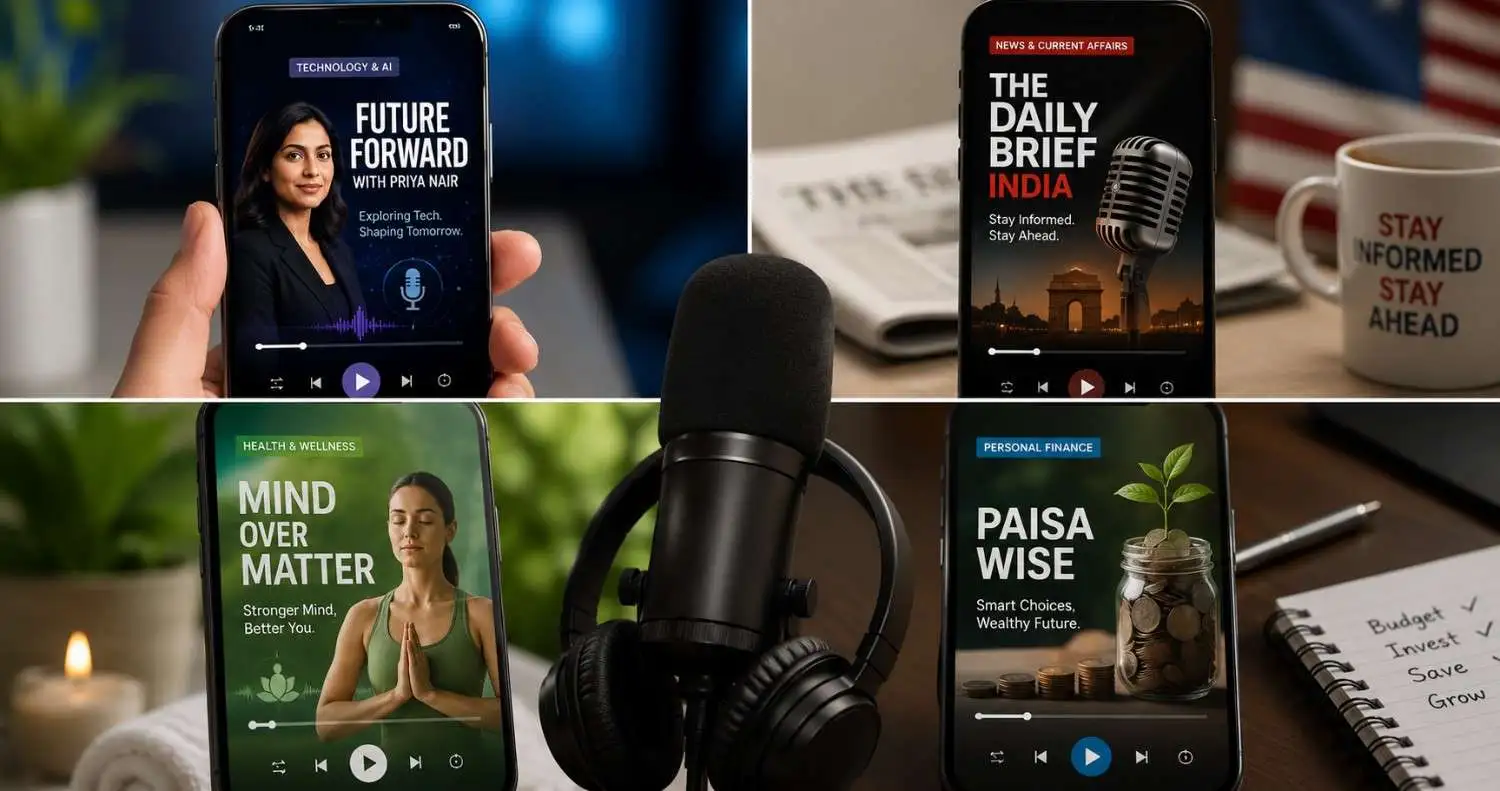
Technology & AI — Future Forward with Priya Nair
AI content has a problem in 2026. There’s so much of it, and most of it either oversimplifies to the point of being useless or goes so deep into technical territory that you need a PhD to follow along.
Priya Nair finds the middle ground better than almost anyone I’ve come across. She was a product manager at a major Bengaluru tech company before going independent, and she uses that experience to bridge the gap between how AI actually works and what it means for people building products, running businesses, or just trying to understand the world they’re living in.
What I appreciate most is that she doesn’t hype things up. When a guest makes a bold claim, she pushes back. That’s rarer than it should be in tech media.
New episodes every Tuesday. Skip the back catalogue and start with the last six months — the earlier episodes are noticeably rougher in production.
Listen on: Spotify, YouTube, Amazon Music
News & Current Affairs — The Daily Brief India
I stopped watching TV news a few years ago. The format just doesn’t work for me anymore — too much repetition, too much noise, not enough substance. The Daily Brief India scratched that itch without replacing one bad habit with another.
Episodes are 18 to 22 minutes, published every weekday morning. They cover national policy, business news, and international stories that actually affect India, and they do it without the theatrical outrage that makes most news hard to listen to.
Production quality is noticeably high — clear audio, tight editing, no rambling intros. It sounds like a team that actually cares about the listener’s time. If you’re preparing for UPSC or just want to stay informed during your morning routine without drowning in noise, this is probably the easiest daily habit you can build.
Listen on: Spotify, Apple Podcasts, YouTube
Health & Wellness — Mind Over Matter
Dr. Sneha Kapoor is a clinical psychologist based in Mumbai, and her podcast sounds like it. Not in a cold or clinical way — in the sense that she actually knows what she’s talking about, which is refreshing in a wellness space full of people who read one self-help book and started recording.
Mind Over Matter covers burnout, anxiety, relationship dynamics, and the kind of low grade stress that most working Indians are carrying around without really naming it. Some episodes are solo explainers. Others are conversations with fellow therapists or people sharing their own experiences.
What makes it work is that Kapoor doesn’t oversell recovery. She doesn’t promise five steps to a better mindset. She talks about mental health the way a good doctor talks about physical health — with honesty about how difficult it can be and realistic expectations about what helps.
Listen on: Spotify, Apple Podcasts
Personal Finance — Paisa Wise
Nobody taught us this stuff in school. That’s essentially the premise of Paisa Wise, and it’s hard to argue with.
Rohit Sharma (a CA) and Deepa Iyer (a certified financial planner) co-host, and their dynamic is genuinely good — they disagree with each other sometimes, which keeps things interesting and means you’re getting more than one perspective. Topics range from how SIPs actually work to whether buying a home in your 20s makes sense anymore, to what happens to your money if you never write a will.
It’s bilingual — a mix of Hindi and English that feels natural rather than forced — which makes it accessible to a much wider audience than most finance content in India. Episodes are around 30 to 35 minutes, which feels just right for a topic that can get heavy fast.
Listen on: Spotify, YouTube, Amazon Music
History & Culture — The History Hour India
This one is hard to describe without it sounding dry, so let me just say: I started an episode about a relatively obscure 18th century regional kingdom while doing dishes and ended up sitting on the kitchen floor for 40 minutes because I couldn’t stop listening.
The History Hour India is beautifully researched and scripted. It covers Indian history in ways that genuinely surprised me — events I thought I knew well turned out to have layers I’d never encountered, and stories I’d never heard at all suddenly felt essential. The host has a background in historical research and it shows in the depth without it ever feeling like a lecture.
If you did well in history class, this will deepen what you already love. If you didn’t, this might be the show that changes that.
Listen on: Spotify, Apple Podcasts, YouTube
Comedy — Laugh Track
Look, sometimes you just need to laugh. Laugh Track is the podcast I put on when I’ve had a long day and don’t want to learn anything or improve myself or optimise anything.
It’s recorded live with a studio audience, which gives it an energy that most comedy podcasts recorded in home studios lack. The guests are mostly from the Indian stand-up scene, plus the occasional writer or cultural commentator who turns out to be unexpectedly funny. Conversations are loose, sometimes chaotic, and occasionally go off on tangents that somehow become the best part of the episode.
Not every episode lands equally. But the ones that do are really good, and even the average episodes are more entertaining than most things in the genre.
Listen on: Spotify, YouTube
Education & Career — Career Compass
This one I’d specifically recommend for anyone who grew up in a smaller city and is figuring out career paths without the benefit of a well-connected network around them.
Career Compass talks to IIT and IIM graduates, UPSC toppers, HR professionals, and people who took unconventional paths and made them work. But it doesn’t feel like a brag session. The conversations focus on what the guests actually did, what they got wrong, and what they’d tell someone earlier in the journey.
Several episodes are in Hindi, which I think is an underrated decision — a lot of the most important career conversations in India happen in English by default, and that quietly excludes a lot of people who deserve access to them.
Listen on: Spotify, YouTube, Apple Podcasts
Creator Economy — Founder’s Table
India’s creator economy is genuinely fascinating right now and deeply underreported. Founder’s Table fills that gap.
Each episode profiles one person — a YouTuber who turned a regional language channel into a full business, a D2C founder who built a brand entirely through Instagram, an app developer who grew an audience before the product even launched — and walks through exactly how they did it. Numbers, strategies, mistakes, what they’d do differently.
It’s specific in the way that most “build your brand” content isn’t, which is why it’s one of the few shows in this space I actually finish every episode of.
Listen on: YouTube, Spotify
Self Improvement — Mindful Mornings
I’m usually skeptical of self-improvement podcasts because they tend to be long on inspiration and short on anything you can actually do. Mindful Mornings is the exception.
Episodes are 12 to 15 minutes, three times a week. That constraint forces the show to be sharp — no padding, no lengthy sponsor reads, no five-minute intros about what you’re about to hear. Just a focused idea, some context, and a practical takeaway. Topics cover habits, communication, decision-making, and the kind of everyday productivity problems that actually affect how your day goes.
It’s the podcast I put on during the gap between waking up and leaving the house. Small window, right kind of content
Listen on: Spotify, Apple Podcasts, Amazon Music
Is There One “Best” Podcast in 2026?
Every platform ranks shows differently. Spotify looks at streams and saves. Apple Podcasts tracks subscriptions and ratings. YouTube measures watch time. A show that dominates one platform might barely register on another.
Honestly, the “best” podcast is the one you actually finish. If it’s teaching you something useful, making your commute better, or just giving you something to look forward to in the morning — that’s the right show for you, regardless of where it sits on a trending list.
A Few Related Questions
Which podcast works best for UPSC prep?
The Daily Brief India for current affairs — it’s accurate, well-edited, and the format fits well with daily revision routines. Career Compass is useful for the optional strategy and interview prep side of things.
Any good Hindi-language options?
Paisa Wise is the most consistently good bilingual show I’ve come across. The Hindi podcast space in general has grown a lot in the past year — it’s worth exploring if you prefer consuming content in Hindi, especially for finance and career topics where jargon in a second language just adds friction.
Best one for someone who’s new to podcasts entirely?
Start with Mindful Mornings — short episodes, no commitment required, easy to fit in anywhere. If you like it, try The DailyBrief India next. Once you’re in the habit of finishing episodes, you’ll naturally find your way to the longer-form shows.
What about AI and tech — is Future Forward too technical?
No. That’s genuinely one of its strengths. You don’t need a technical background to follow it. If anything, listeners with engineering backgrounds sometimes find it moves too slowly through the basics — but for most people, the pace is just right.
How I Put This List Together
I’ve been covering digital media and audio content for eight years. This list came from six months of actual listening across 200+ shows — not press releases, not PR pitches, not download numbers.
The criteria I used: Does the host actually know their subject, or are they just good at sounding like they do? Does the show publish consistently, or does it disappear for six weeks and come back with an episode apologising for the gap? Is the audio quality good enough that I’m not constantly distracted by it? And most importantly — did I finish the episode, or did I switch to something else halfway through?
Every show on this list passed all four. None of them paid to be here.